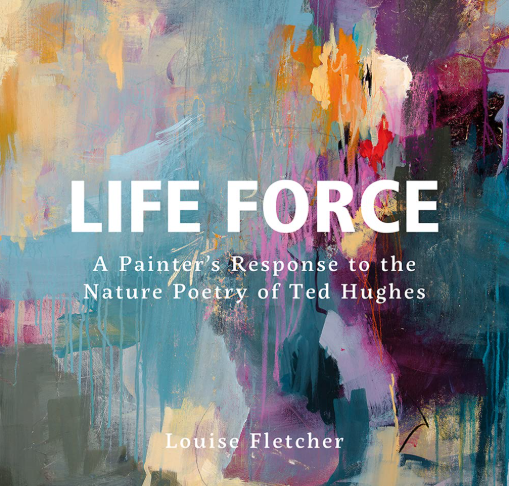
Life Force: A Painter’s Response to the Nature Poetry of Ted Hughes, by Louise Fletcher
reviewed by Barbara Lehtiniemi
” We are not here to hone our skills to perfection, to make accomplished paintings, or to create things that match the furniture. We are here to express ourselves as truthfully and bravely as possible. ” – Louise Fletcher
In 2019, award-winning abstract painter Louise Fletcher set out to create a body of work that responded to the nature poetry of Ted Hughes. In Life Force, Fletcher recounts her journey from concept to research to preliminary work, followed by doubt and dithering, and then the final breakthrough and completion.
Fletcher first encountered the poetry of Ted Hughes at age 15 and sensed an energy in them her young mind could not indentify. She read Hughes’s poetry “voraciously” and it became her focus of study in university. She later made Hughes’s nature poetry the subject of her dissertation.
After a corporate career that took her from her native Yorkshire to Toronto to Connecticut, she returned to her first loves: art and the Yorkshire Pennines.
Back in Yorkshire, Fletcher experienced such a connection to the landscape that “every tree, every blade of grass and every stone in every dry stone wall” spoke to her. She dug out her books of Ted Hughes’s poems. Since Hughes had spent his youth in a valley near where Fletcher now lived, she found his poetry resonated with her surroundings.
The return to Yorkshire rekindled Fletcher’s interest in art. For a long while, her re-awakened interest in painting and in Hughes’s poetry progressed separately. “But one day, as I read the poem ‘Wind’ yet again,” Fletcher writes, “I thought, ‘I should paint this.'” The idea of painting one poem blossomed to a body of work drawn from Hughes’s volume Collected Poems.
Before painting, Fletcher researched, reading all she could about Hughes. She also read reviews of his poetry. Drawn particularly to Hughes’s poems about the landscape and the natural world, Fletcher visited the places that inspired him. She made notes and sketches, and tried to absorb the surroundings into her imagination.
Fletcher didn’t set out to create paintings that were “mere illustrations” of the poems, but ones that reflected her experience of the words. As she read and re-read the poems, she made lists of words and phrases that particularly spoke to her.
Then Fletcher began to paint.
Despite all Fletcher’s preparation, and her meticulous analysis of many of Hughes’s poems (she sometimes wrote poems out by hand, “just to feel the rhythm and depth of the words”), the project didn’t flow. Many paintings stalled before completion, with Fletcher unable to resolve what she wanted the paintings to represent.
After what Fletcher describes as her “dark night of the soul”, she realized she would have to let her “white-knuckled grip” on the project go, and instead let her intuition take over. The results were paintings that, instead of being about the poems themselves, reflected Fletcher’s own response to the poems.
I found Life Force a fascinating read. Not only for the intriguing concept of an artist in one medium paying homage to an artist in another, but also for Fletcher’s description and observations about the process of creating the art.
I haven’t yet found my way in to an appreciation of purely abstract art—but I did admire Fletcher’s use of colour, materials, and technique. I’m also not familiar with Ted Hughes’s poetry, so I was glad Fletcher included some snippets in her book (she also included some photos of the Yorkshire landscape.)

I found it refreshing to know skilled and successful artists like Fletcher experience doubt and despair, and sometimes they stumble and stall. I like that Fletcher’s ambitious project blossomed after she quit trying to force the process to follow a planned path, and instead just let it become what it was meant to.
Life Force (2021, Bird Eye Books) is a coffee-table-worthy book at 2.5 lbs, but totally worth its weight in full-colour plates of the paintings—a feast for the eyes. The final third of the book contains full-page illustrations of Fletcher’s paintings, many of which are accompanied by her reflections on creating each painting, and which of Hughes’s poems served as her inspiration.
Life Force is available through most book retailers; I had the good fortune to borrow a copy from collective member Yvonne.
 Collectif